
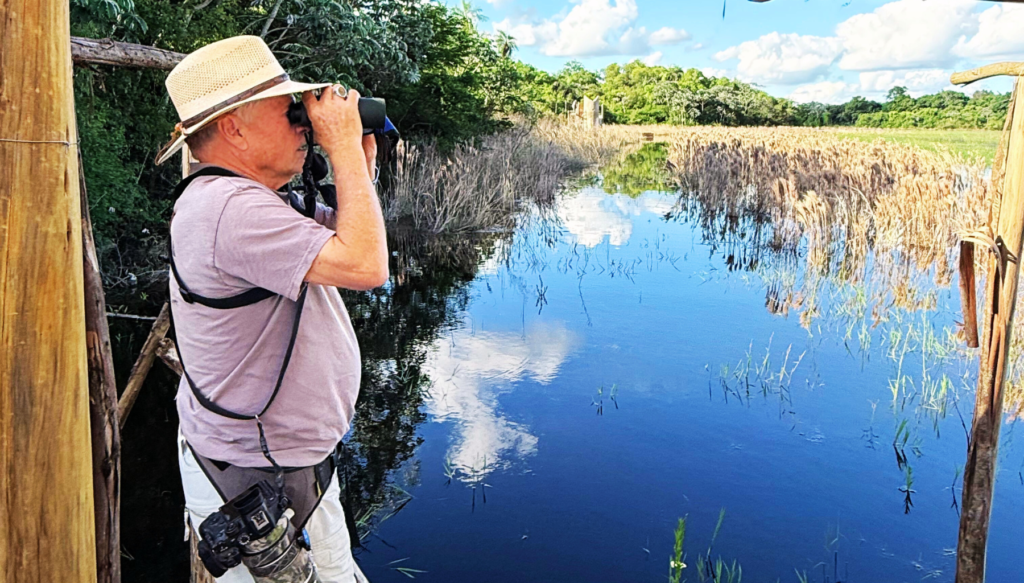
⚡ Choose Fast: Your Ideal Binocular For Iberá (in 30 seconds)
| Scenario | Recommendation |
| 🛶 Long canoe days, sunrise/sunset | 8×42 Full-Size |
| 🥾 Mixed hiking + Wetland safari | 8×32 Compact |
| 👓 Daily use + Glasses | 8×42 (Look for 16+ mm eye relief) |
| ⚖️ Best Value / Mid-Range | Vortex Viper HD 8×42 |
| 🎒 Minimalist / Backup | 8×25 Pocket |
| 💰 First purchase, tight budget | Nikon Prostaff P7 8×32 |
Introduction: Why This Guide Exists
“A Jabiru taking flight between marsh reeds, a Maned Wolf emerging at dusk, a Night Heron hunting in twilight… these are moments of gold.”
After 15+ years leading expeditions in Esteros del Iberá, I noticed a pattern: observers with inadequate equipment missed these unforgettable moments. Good equipment captures them perfectly; poor equipment makes you lose them forever.
This guide isn’t generic. It’s written for Iberá, from Iberá, addressing real wetland challenges: extreme humidity, light reflection, moving boats, and extended twilights.
If you plan to observe here—whether tourist, naturalist, or biologist—you deserve to know what to bring.
🌿 Why Esteros del Iberá Demands Special Binoculars
The wetlands of Corrientes present unique challenges you won’t find in mountain or forest ecosystems:
- ☀️ Intense water light reflection: Mirror-like water surfaces bounce extreme glare. You need quality lens and prism coatings to avoid red/blue halos and maintain contrast against bright water.
- 🌅 Extended twilight window: Water reflections extend usable viewing light by 10–15 minutes compared to forests. To use this “prime time,” you need a large exit pupil (5+ mm).
- 💧 Extreme humidity + fog: With humidity often exceeding 80%, internal condensation is inevitable in cheap optics. Nitrogen purging is non-negotiable.
- 🛶 Weight critical in canoe: After 4 hours on a boat, your neck carries real strain. A chest harness becomes essential once you approach 900 g+.
- 🐊 Variable distances: You’ll observe caimans at 2 meters and herons at 50 meters. You need flexible focus.
🔢 How to Read Specs (8×42 / 8×32 / 8×25)
You’ll see two numbers: 8×42, 10×32, 7×25. Let’s decode:
1. The First Number: Magnification (8× vs 10×)
- 8× (The Winner): Things appear 8 times closer. Superior for wetlands because it amplifies canoe vibration less than 10× and offers a wider field of view.
- 10× (The Risk): More reach, but requires jeweler-level steady hands. In a moving boat, the trembling becomes exhausting.
Rule: For Iberá, 8× is the standard. Only choose 10× if you’ll observe primarily from stable ground.
2. The Second Number: Objective Diameter
- 42 mm: Captures more light. Ideal for twilight. (Exit pupil: 5.25 mm).
- 32 mm: The balance. Gains portability, sacrifices some twilight brightness. (Exit pupil: 4 mm).
- 25 mm: Ultraportable but limited. Poor in twilight forest scenes. (Exit pupil: 3.1 mm).
🛠 Critical Specs For Wetlands
👓 Eye Relief (Critical for Glasses Wearers)
This is the distance your eye can be from the eyepiece while still seeing the full picture.
- ✅ Excellent: 16+ mm (Perfect for glasses)
- 🟡 Good: 14–15 mm (Acceptable, may be tight with thick frames)
- 🔴 Poor: < 14 mm (You will lose field of view)
🌈 Prisms and Coatings (The Glare Killers)
To fight water glare, look for these on the spec sheet:
- ✅ “Fully multi-coated” (Lens coatings)
- ✅ “Dielectric prism coating” (Boosts light transmission & sharpness)
- ⚠️ Avoid: “Silver-coated” or “Aluminum” prisms. They are cheaper but produce a dimmer image in twilight.
🔭 Field of View (FOV) at 1000 m
Wider FOV = easier to locate wildlife moving through reeds.
- 8×42: ~120–145 m (Standard Wide)
- 8×32: ~130–150 m (Often wider than 42mm—exceptional for bird tracking)
- 8×25: ~95–110 m (Narrow, requires more panning to find birds)
📏 Close Focus Distance
Capybaras often appear right next to the boat.
- 🟢 Excellent: ≤ 3 m (Perfect)
- 🟡 Good: 3–5 m (Standard)
- 🔴 Poor: > 8 m (Avoid)
🛡️ Seal + Nitrogen Purging
🚩 Red Flag: “Weather-resistant” without explicit purge mention.
✅ Look for: “Waterproof” + “Nitrogen (or Argon) purged”.
🏆 Full-Size (8×42): The Naturalist’s Standard
Ideal for: Long canoe expeditions, sunrise/sunset observation, professional guiding.
| ✅ The Good | ❌ The Bad |
| Unrivaled brightness in twilight. | Weight: 750–950 g (needs harness). |
| Stability in moving canoes. | Volume: Bulky in the bag. |
| Comfort (Big eyecups). |
Recommended Models
💎 Premium Range
- Swarovski EL 8.5×42 (~$2,100+): The “gold standard” for guides. Legendary optics.
- Zeiss Victory SF 8×42 (~$2,800+): Unbeatable field of view and balance.
⚖️ Mid-Range & Best Value
- Vortex Optics Viper HD 8×42 (~$500–$600): Rugged, dielectric coatings. Eye Relief: 17.5 mm (Excellent for glasses).
- Nikon Prostaff P7 8×42 (~$190): Best budget 8×42. Waterproof, dielectric prism coatings. Eye Relief: 20.2 mm (Superb for glasses).
⚖️ Compact (8×32): The Hiker’s Balance
Ideal for: Full-day hikes, mixed hiking/boating, travelers with limited luggage.
| ✅ The Good | ❌ The Bad |
| Lightweight (450–550 g). | Twilight Limit: Dims in the last 15 mins. |
| Wide FOV for bird tracking. | |
| Daylight performance rivals big bins. |
Recommended Models
- Vortex Optics Viper HD 8×32 (~$480): Professional quality, small package. Eye Relief: 16 mm.
- Nikon Prostaff P7 8×32 (~$170): Extremely lightweight (~450 g). Wide field of view. Eye Relief: 15.4 mm (Good).
🎒 Pocket (8×25): The Minimalist Backup
Ideal for: Backup in the canoe (safety), casual tourists.
| ✅ The Good | ❌ The Bad |
| Tiny: You forget it’s there. | Darker Image: Struggles in forest/dusk. |
| Safety: Essential backup. | Comfort: Small eyecups fatigue eyes. |
Conclusion: Choose By Size First, Model After
Esteros del Iberá demands more from your binoculars than most ecosystems.
- Serious Naturalist/Guide: Invest in 8×42. It owns the twilight.
- Hiker/General Tourist: 8×32 is the perfect balance.
- Minimalist: 8×25 is a backup only.
📝 Note on Brands: We recommend reliable brands like Nikon, Vortex, Zeiss, or Swarovski because they are field-tested in Iberá conditions. Other brands exist, but always verify strictly for “waterproof + nitrogen purged” warranties.
Choose wisely. Your neck, and your wildlife moments, depend on it.
🌿 Ready to Test Your Gear?
Theoretical knowledge is good, but seeing a Yacaré Caíman directly in the eyes is better.
At Esteros del Iberá Lodge, we specialize in guiding photographers and nature lovers to the best spots in the wetlands.
👉 Book Your Iberá Wetland Safari
Don’t have binoculars yet? Ask us about rental equipment available for our guests.